
The 19e arrondissement is located on the northeast corner of Paris and is named Buttes-Chaumont after a popular park in the area. The 19e is a lively area packed with new parks and renewed 19th-century public spaces. If you’re seeking a park or bar terrace to spend the day, look no further. In fact, the area has more park space than any other arrondissement if we ignore the large wooded areas of Bois de Vincennes and Bois de Boulogne.
A quarry transformed into a dynamic park
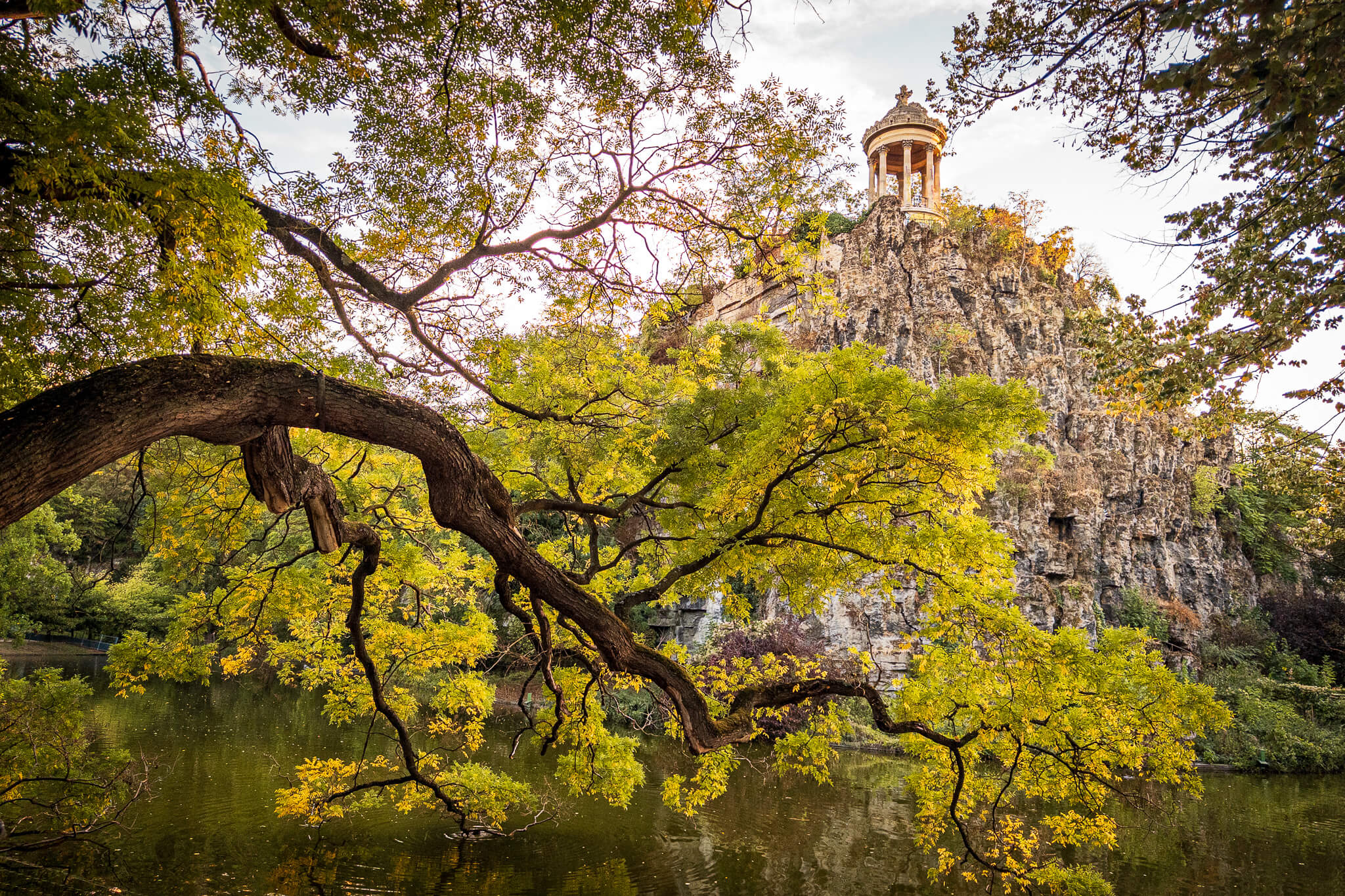
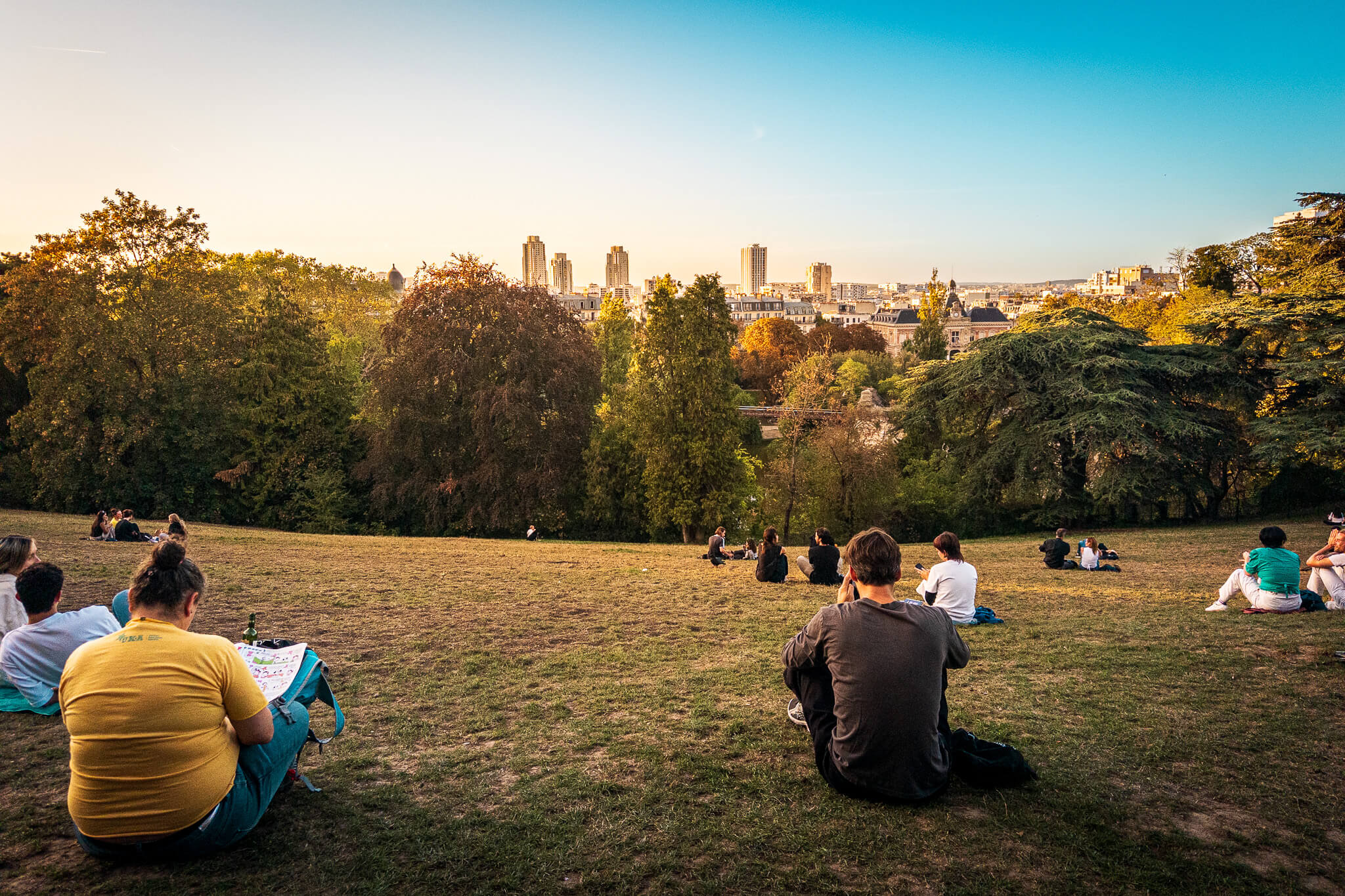
Parc des Buttes-Chaumont is a large public park (the fifth-largest in Paris), designed like an English garden with a rocky mountain surrounded by a lake, an artificial waterfall and cascading river, bridges and winding paths, grottos and expansive grassy lawns. There are even a few full-service restaurants within the park (modelled after Swiss chalets), in addition to some smaller food carts. The park opened in 1867 towards the end of the reign of Napoléon III, with some of the larger trees being original plantings.
The name Chaumont is rumoured to come from chauve-mont (bare hill) as the area was completely barren prior to being turned into a park. It is the site of a former limestone and gypsum quarry, to which it owes the 40-metre elevation difference within the park. It took years (and dynamite) to reshape the land for the park, and 200,000 cubic metres of topsoil were brought in by train. Before the quarry, the area was home to the monumental medieval stone gallows and gibbet known as Gibbet of Montfaucon, used by the kings of France from the 13th century through to 1627 (and dismantled in 1760).
The 65-metre suspension bridge to the central island Île du Belvédère was designed by Gustave Eiffel. The island is topped by a small pavilion, the Temple de Sibylle, inspired by a Roman temple. (The island area is currently closed while they remediate unstable and unsafe ground.)
Reclaimed infrastructure turned recreational
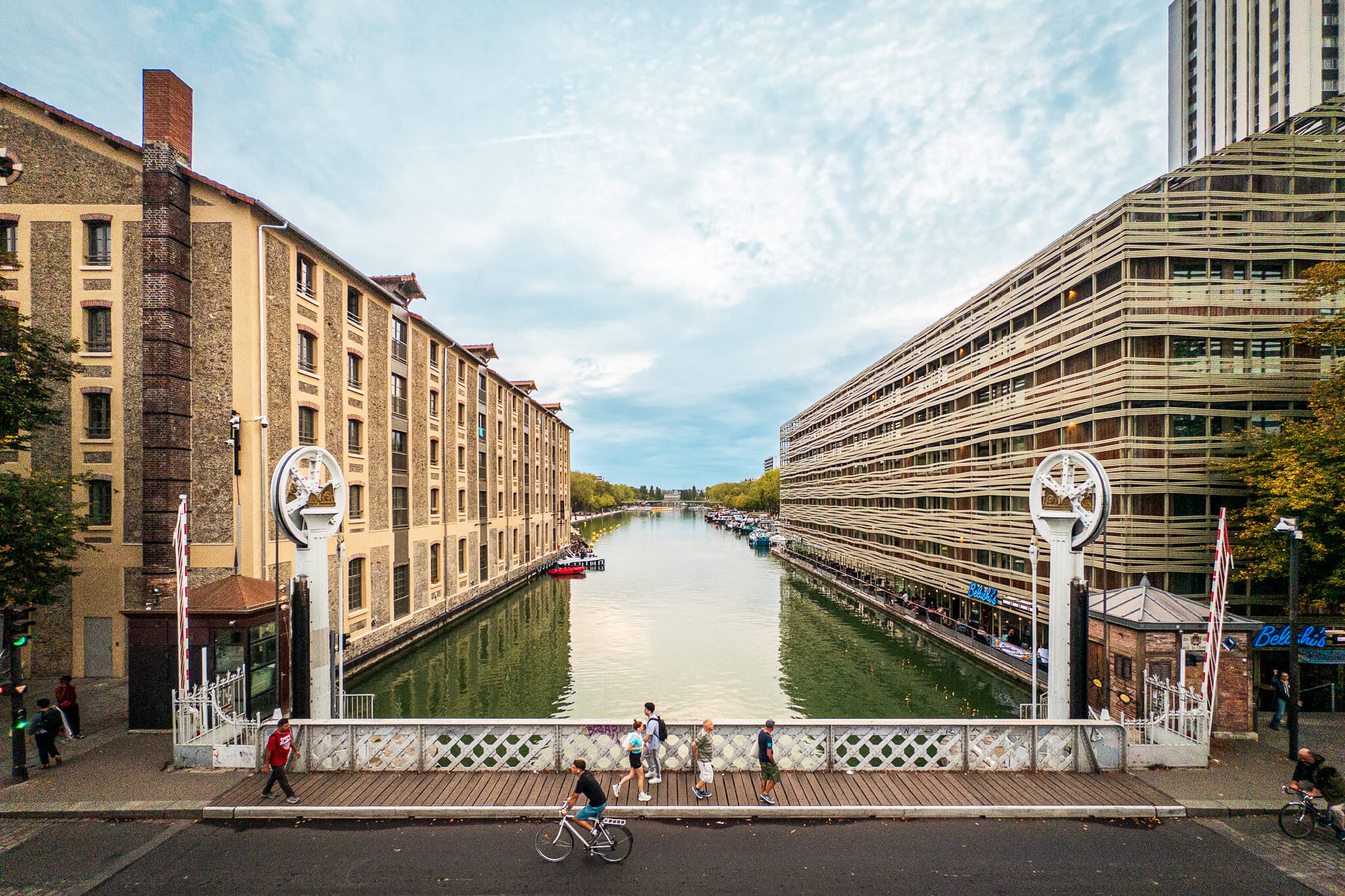
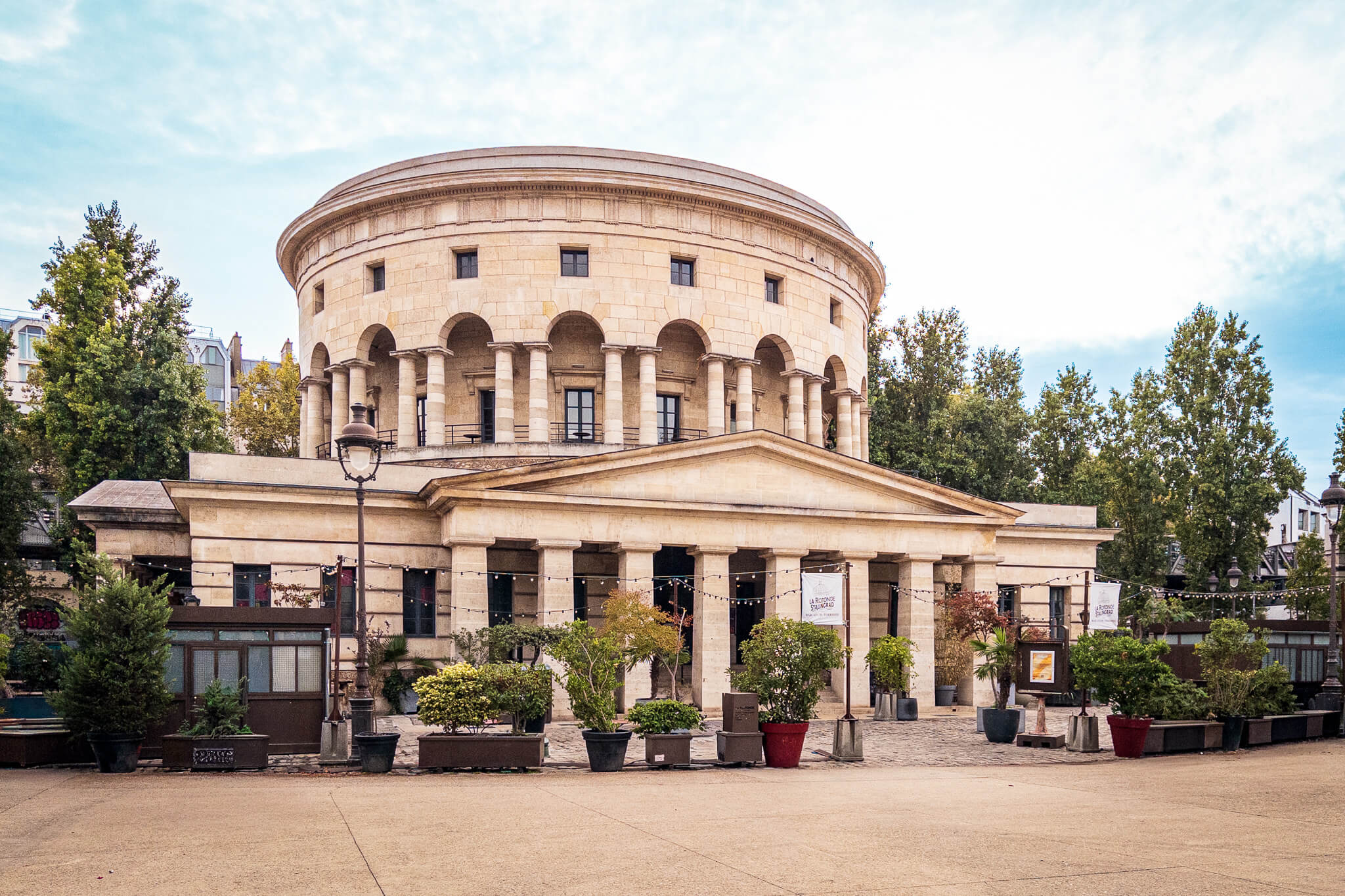
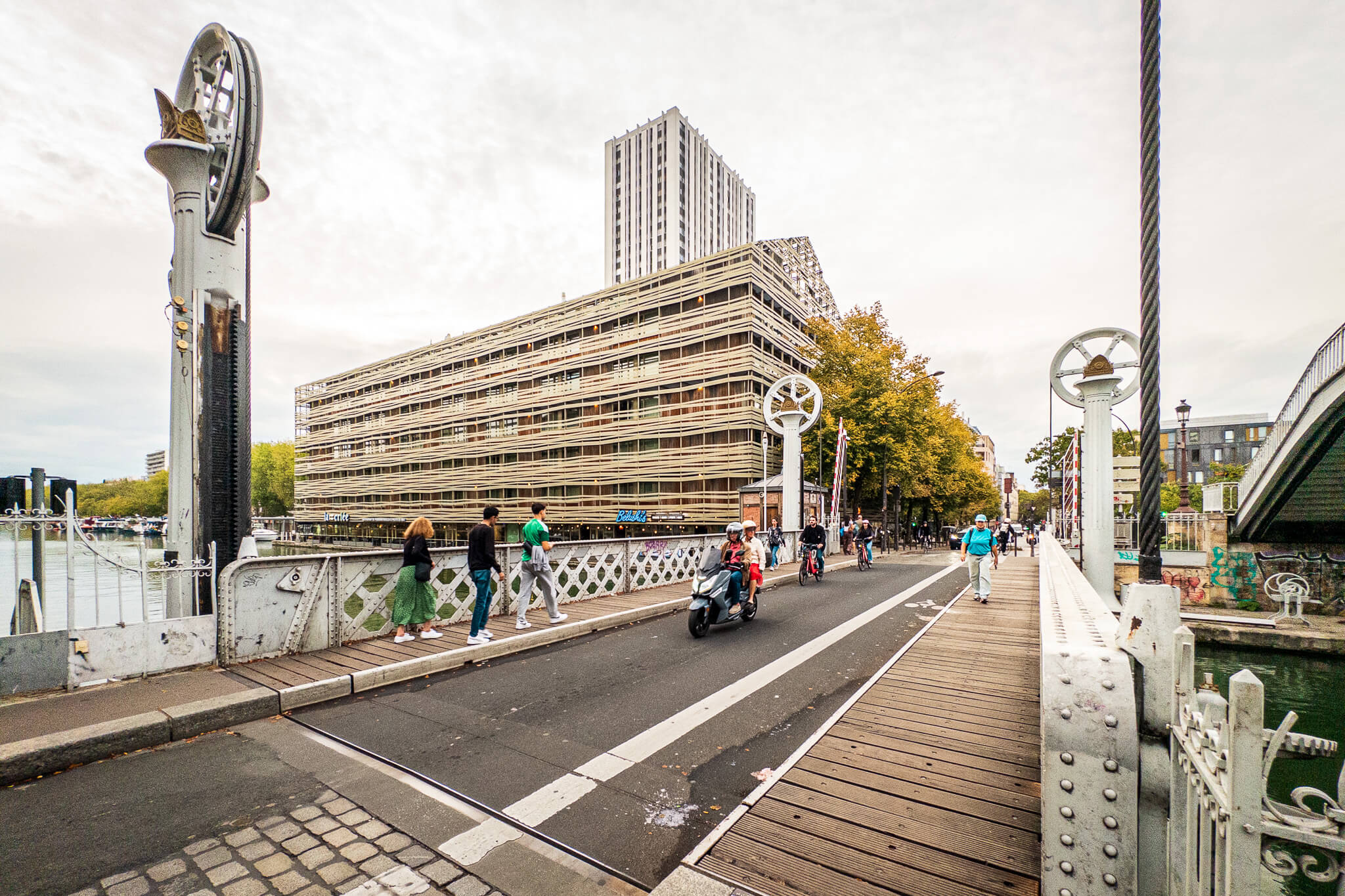
Bassin de la Villette is described as the largest artificial lake in Paris, measuring 800×70 metres. It was first flooded in 1808 to provide a source of drinking water, and links the Canal de l’Ourcq to the Canal Saint-Martin. It was soon surrounded by gardens and terraces, which we still have today. The basin is lined with movie theatres, shops, bars and outdoor patios, all buzzing with people. Paths on either side are busy with locals enjoying the space or going for a run. There’s even a small beach and swimming area. While it is no longer a source of drinking water for Paris, it does provide about half the non-potable water Paris requires for cleaning the sewer system, gutters and parks.
At the south-west end of Bassin de la Villette (where it flows into Canal Saint-Martin), we find the Rotonde de la Villette (or Rotonde Stalingrad). Built in the 1780s, the neoclassical structure was originally a tollgate in the old city wall used for collecting taxes on goods entering Paris. That purpose ended with the revolution. Today it houses a restaurant and cultural hub.
At the opposite end of Bassin de la Villette (where it meets Canal de l’Ourcq) are a pair of buildings constructed around 1850 as commercial warehouses, storing grain and flour. Today they house restaurants, offices and workshops.
Just behind these buildings is the Pont de Crimée, the last remaining vertical-lift bridge in Paris, built in 1885.
The newest major park of the 19e
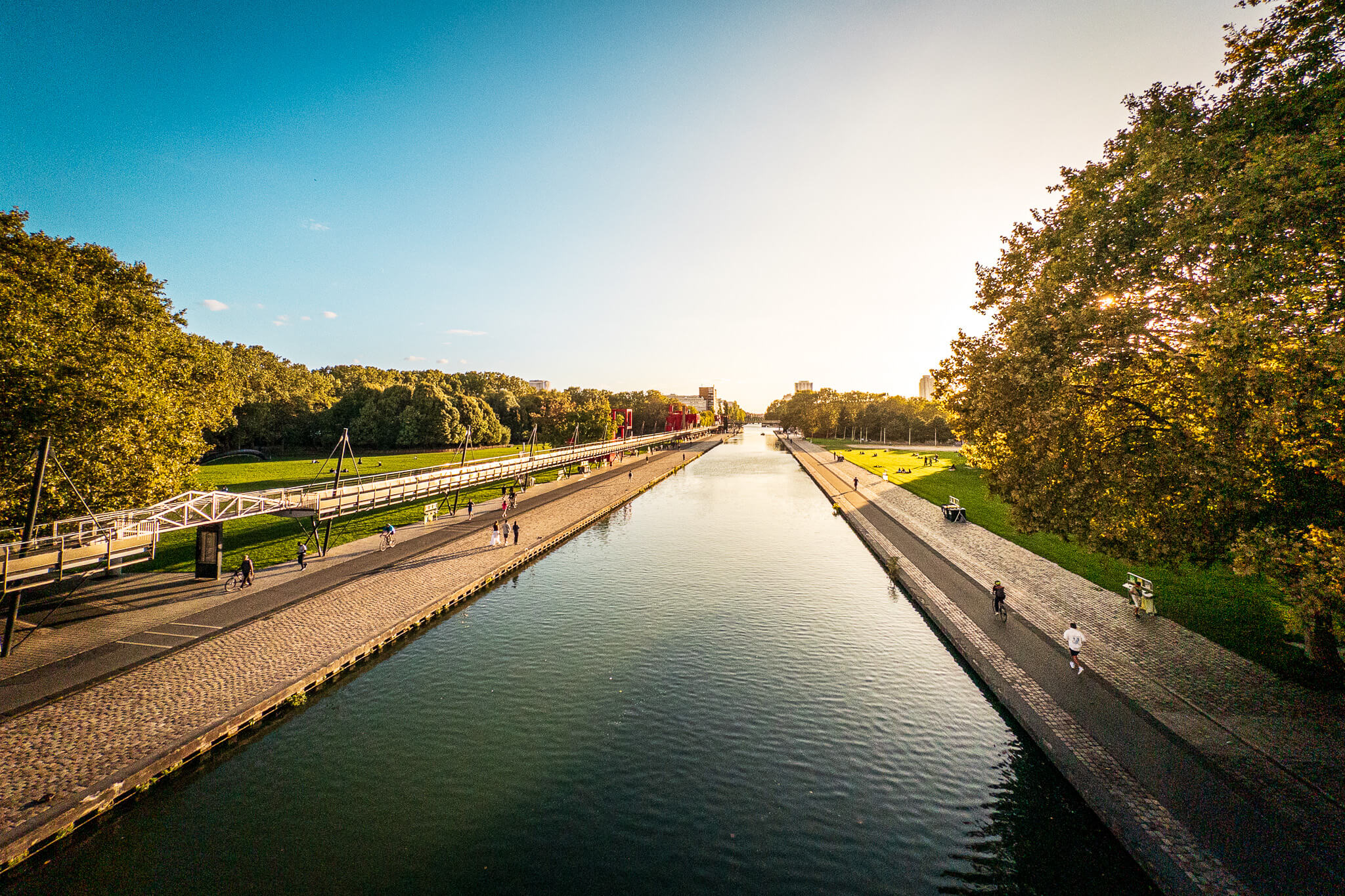
A short walk upstream along Canal de l’Ourcq is Parc de la Villette, another large park in the 19e arrondissement, inaugurated in 1987 but under constant evolution. When we first entered the park, we were quite disoriented, only to learn this was the precise goal of its design. This park was a François Mitterrand project replacing obsolete Napoléon III infrastructure. At the same time Napoléon III and Haussmann were creating Parc des Buttes-Chaumont, they were consolidating the city’s abattoirs and livestock market to the site that is now Parc de la Villette. Before this, Napoléon I had banned private abattoirs and established 5 city abattoirs in the outskirts of the city to keep livestock and their slaughter away from the centre of the city, but with the expansion of Paris under Napoléon III, these were now within the city.
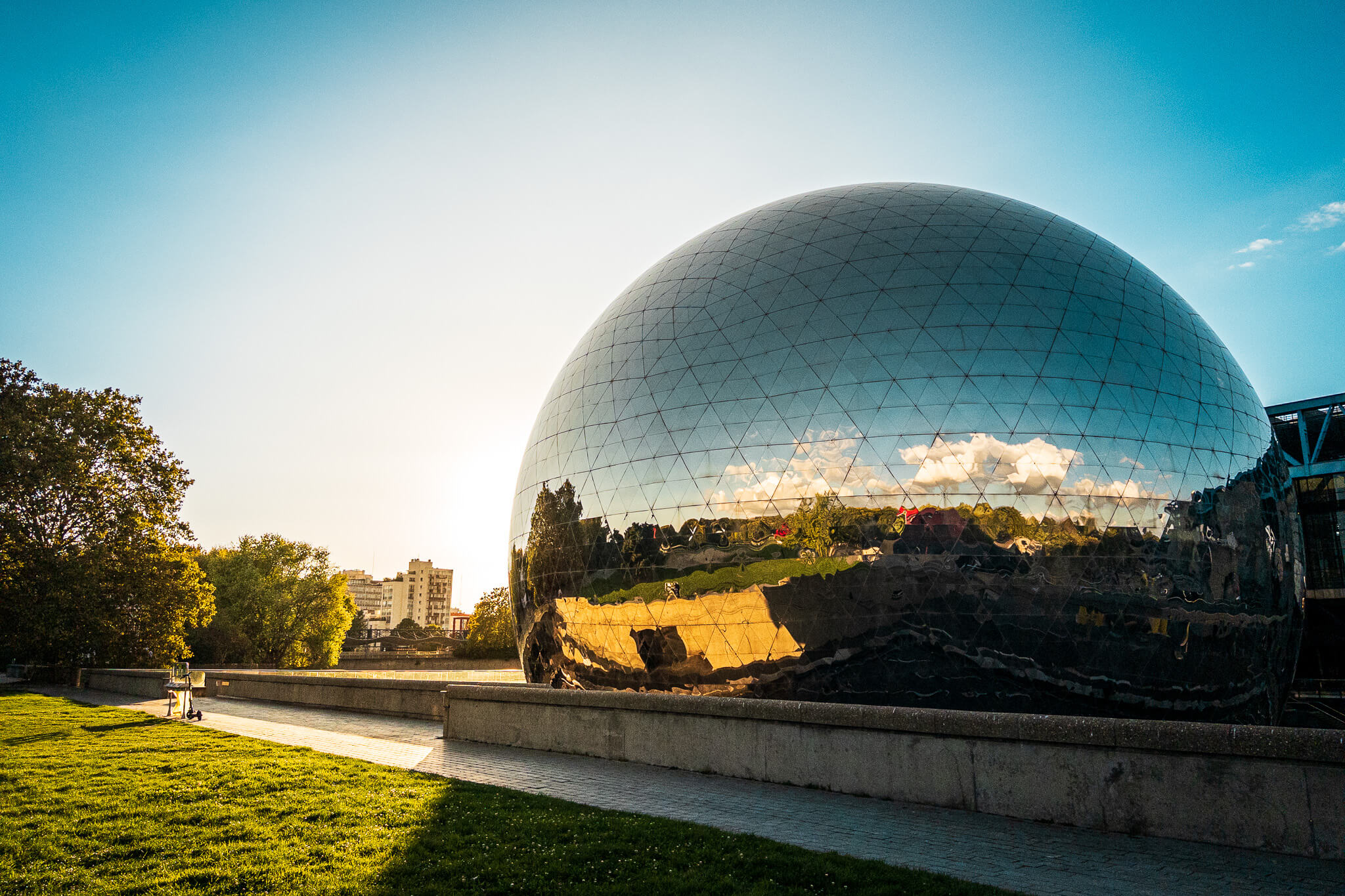
The abattoir and livestock market closed in 1974 when operations were decentralized and moved closer to livestock production areas outside Paris. Parc de la Villette was inaugurated in 1987 and contains museums, several concert halls and theatres, playgrounds, workout areas, elevated walking and running paths, lawns, gardens and water features. The park is home to the Cité des Sciences et de l’Industrie, the largest science museum in Europe; La Géode, an mirrored geodesic dome containing an IMAX theatre; Cité de la Musique, a music museum and home to the Conservatoire de Paris; the Philharmonie de Paris symphony hall.
The park is designed using a unique deconstructed, anti-tourism design. Paths criss-cross, with bridges and tunnels, and there are multiple ways to get from point A to B, although if you’re trying to get to B, you’ll probably end up at C first. There are spaces with no rigidly-defined purpose, rather letting users decide how they want to use a space. In many ways, the park isn’t the destination, but rather a tool for human activities. Ambiguous red “folly” structures throughout the park often don’t have any real purpose other than acting as a directional landmark. The design has proven quite successful, as this is one of the most dynamic and well-used parks we’ve visited in Paris.
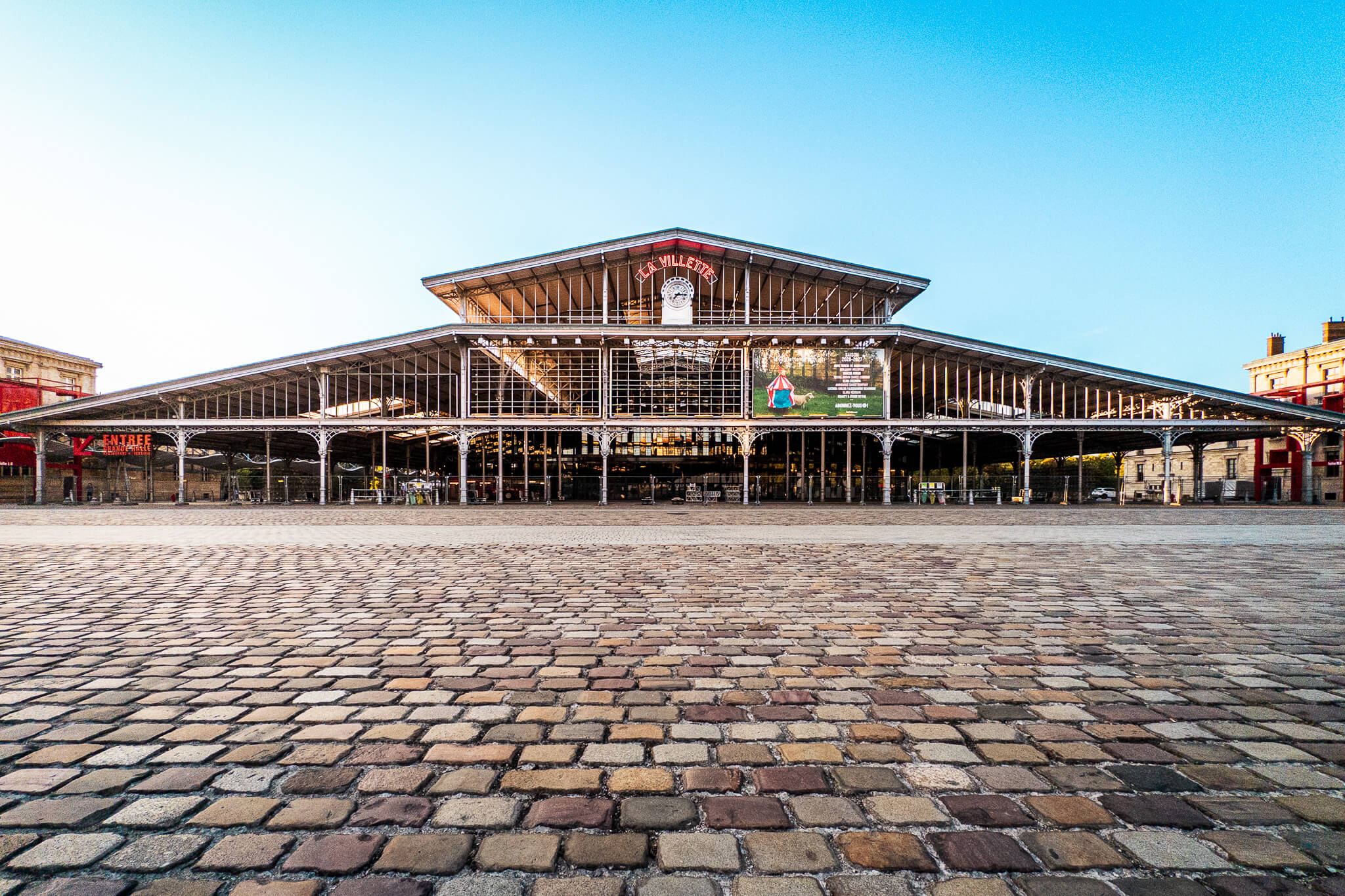
The park preserves and incorporates many remnants of the abattoir and livestock market. The Grande Halle de la Villette, a 20,000 square metre hall of iron and glass was the main livestock market holding up to 5,000 cattle. (A separate calf market was in poor condition and demolished, while the sheep market was dismantled to move elsewhere but never did.) Today the Grande Halle is a cultural centre used for exhibitions and concerts, and also contains a restaurant.
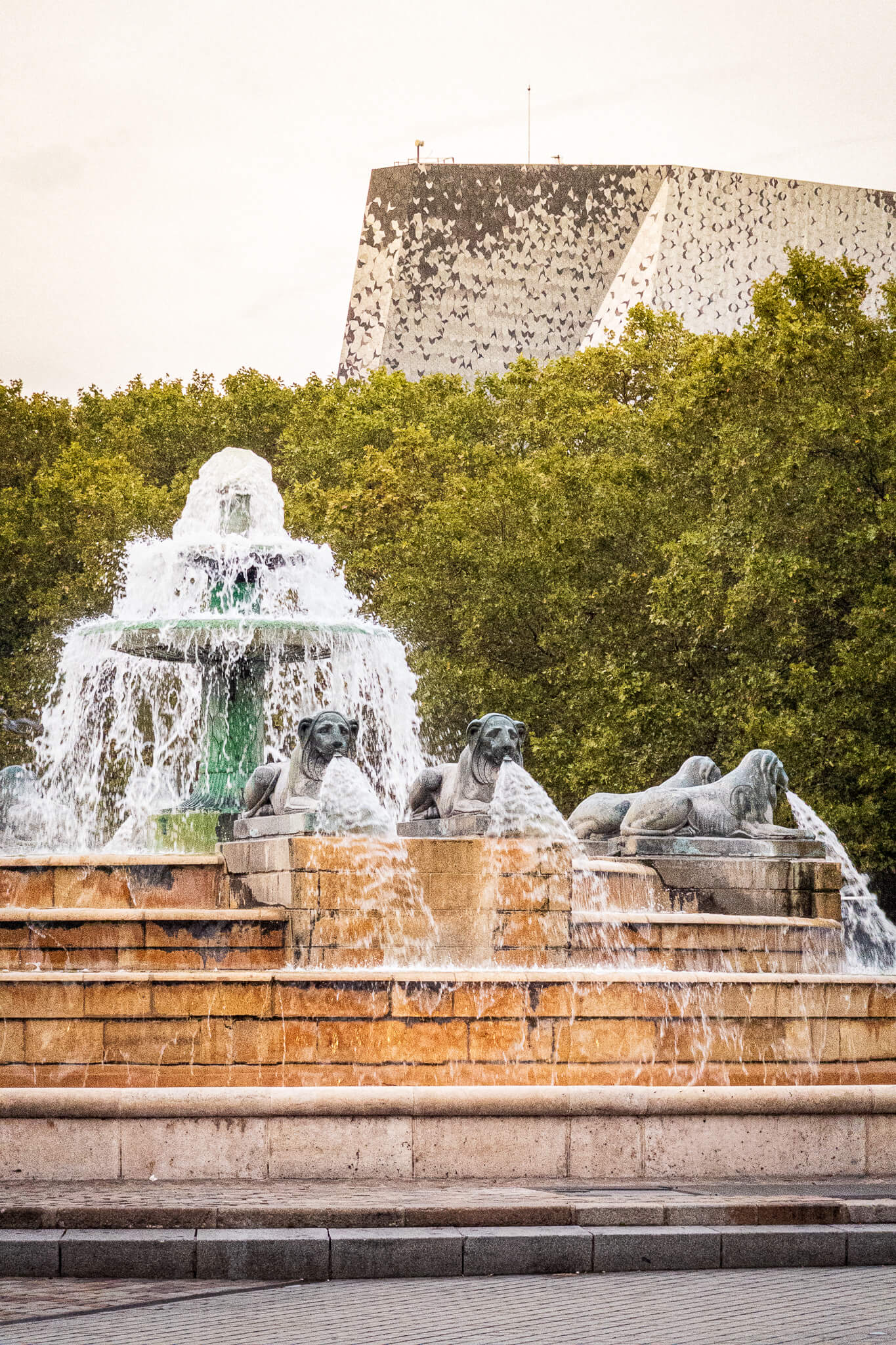
The fountain with the lions on front of the Grande Halle, called either Fontaine du Château d’eau or Fontaine aux Lions de Nubie, dates from 1811 and was moved to the market in 1867 to serve as a watering trough for cattle.
A world-class concert hall
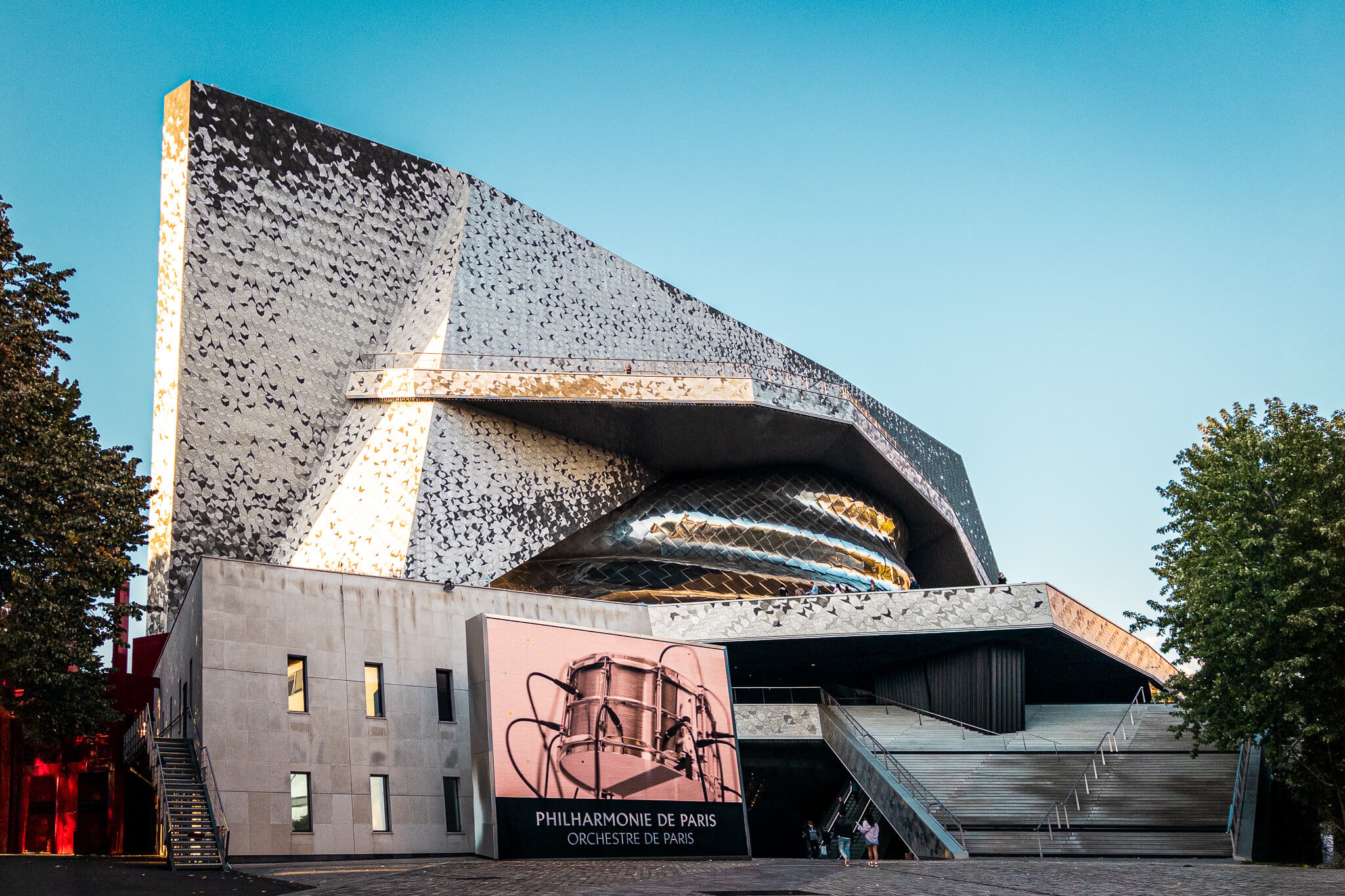
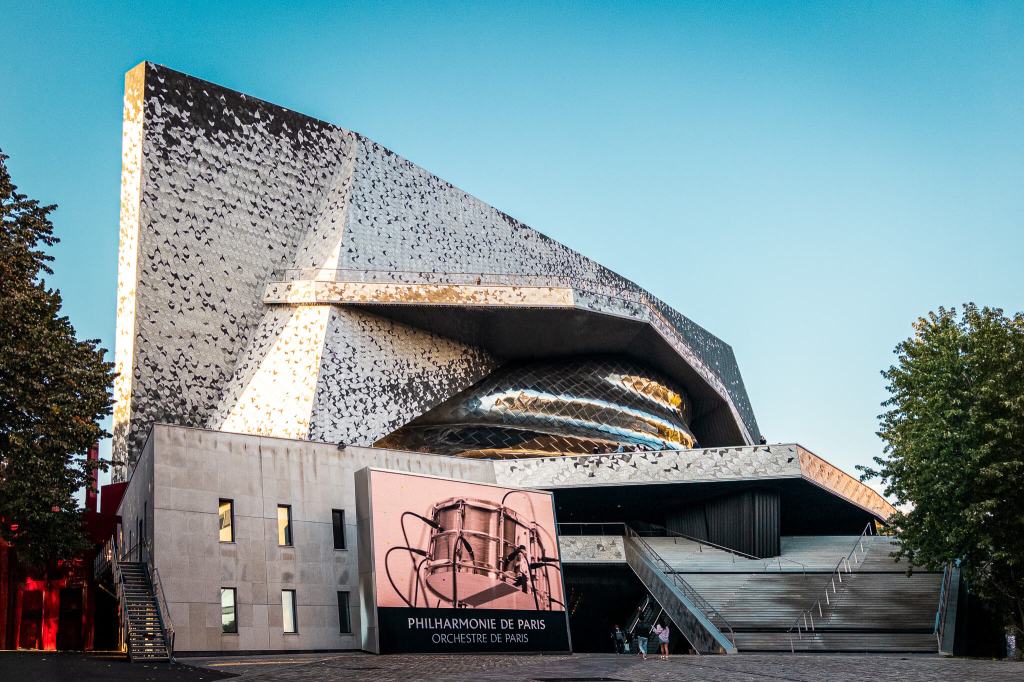
We didn’t set out to see a show at the Philharmonie de Paris, but after seeing its architecture, we decided we needed to get inside and test it out. Nestled into the corner of Parc de la Villette, the building emerges from the forest like a small rocky mountain. The building is oddly organic, clad with 340,000 bird-shaped aluminum tiles in shades of grey and black. Like Parc de la Villette, it’s not immediately clear how to access the building because there are no visible front doors… you just need to follow a staircase or ramp and trust it will take you there (they all do).
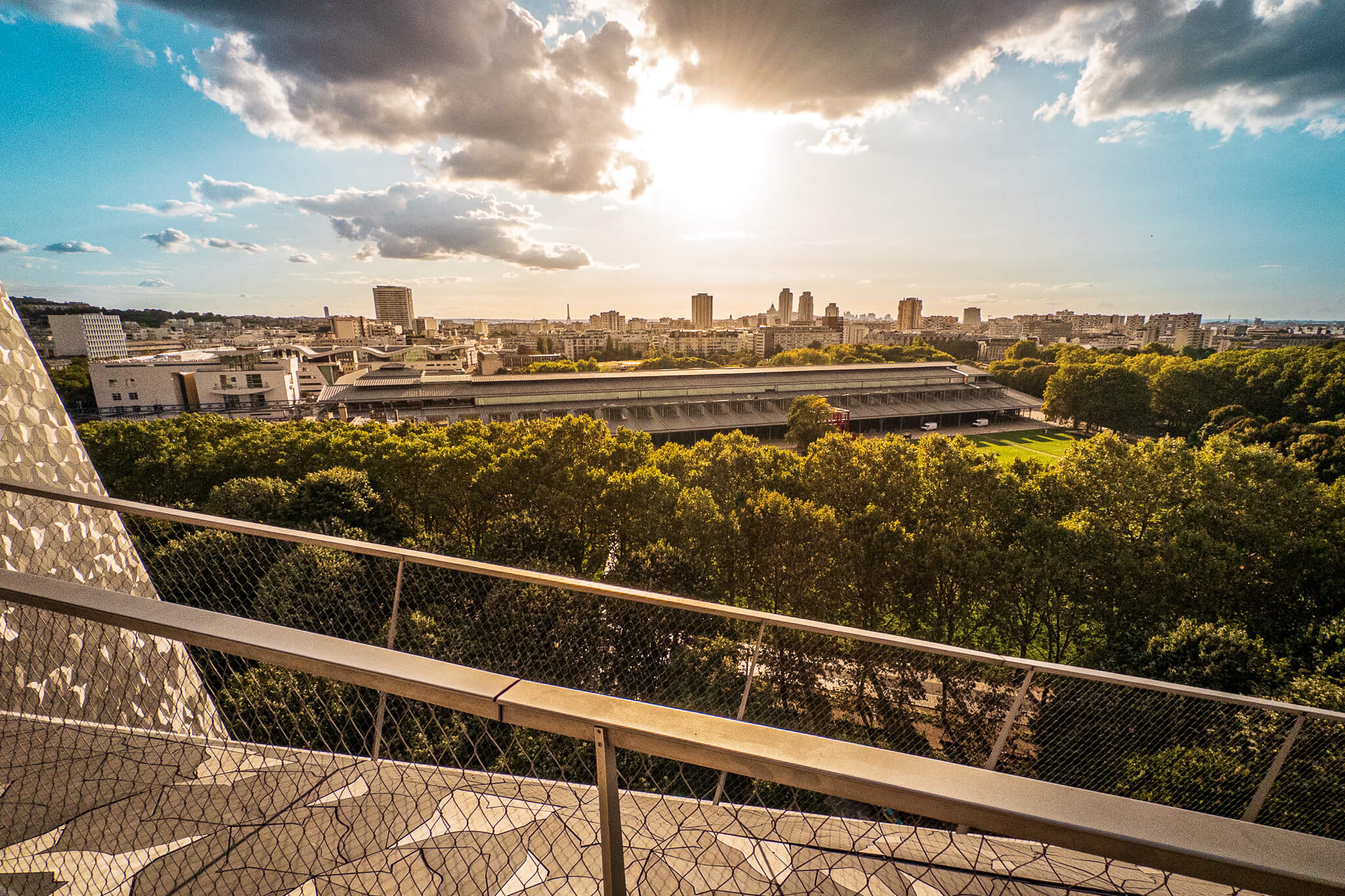
The staircases also lead to slanting paths up to the roof of the Philharmonie, which offers a panoramic view of the northeast side of Paris.
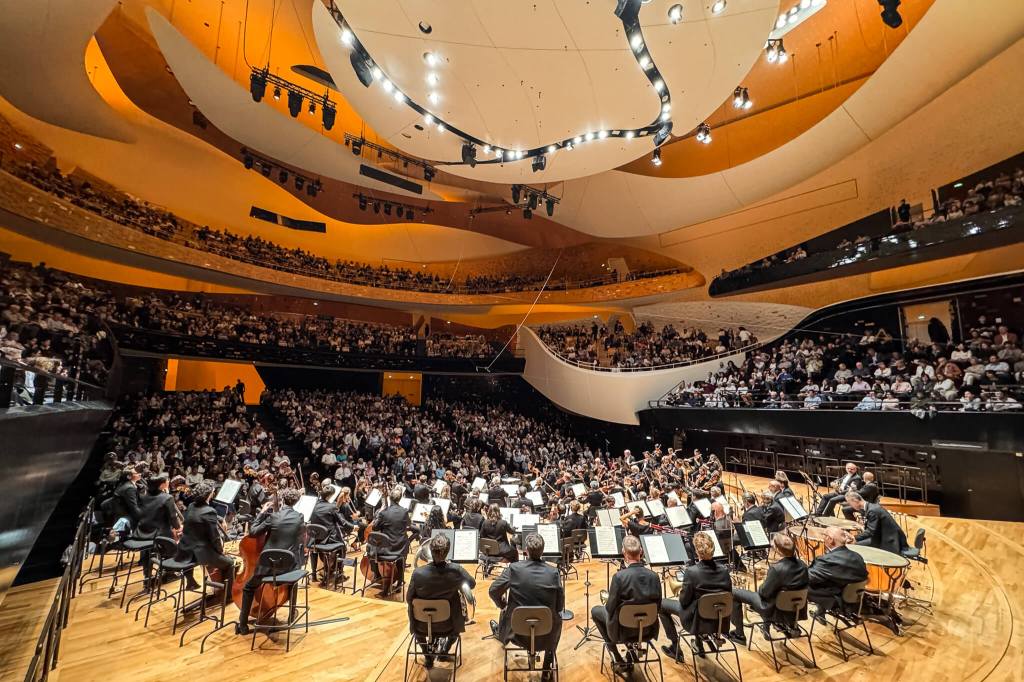
The venue opened in 2015 as a new permanent home for the Orchestre de Paris, Les Arts Florissants and a few other orchestral ensembles. (After seeing the former, we returned for the latter.)
The Philharmonie was by far the most inviting performance space we visited in Paris. It’s a fluid, flowing space that sucks you in. Inside, numerous staircases take you from level to level with ease, and there are lounge spaces throughout to enjoy a glass of wine before the show.
The performance hall is a spacious 2,400-seat auditorium that eschews standard concert hall design. The balconies are broken up into discrete curved spaces, separated from the wall and floating in the room. At the same time, acoustics were carefully considered, merging both form and function in a beautifully modern way. We’d return in a heartbeat.
With our itinerary based around visiting a few parks, we didn’t fully know what to expect with the 19e arrondissement. But we were blown away with the size, design and liveliness of both Parc des Buttes-Chaumont and Parc de la Villette. Bassin de la Villette is also an area we’d love to return to enjoy some wine on a restaurant terrace overlooking the water. Definitely a standout area in Paris to simply enjoy modern Parisian life.


Leave a comment