
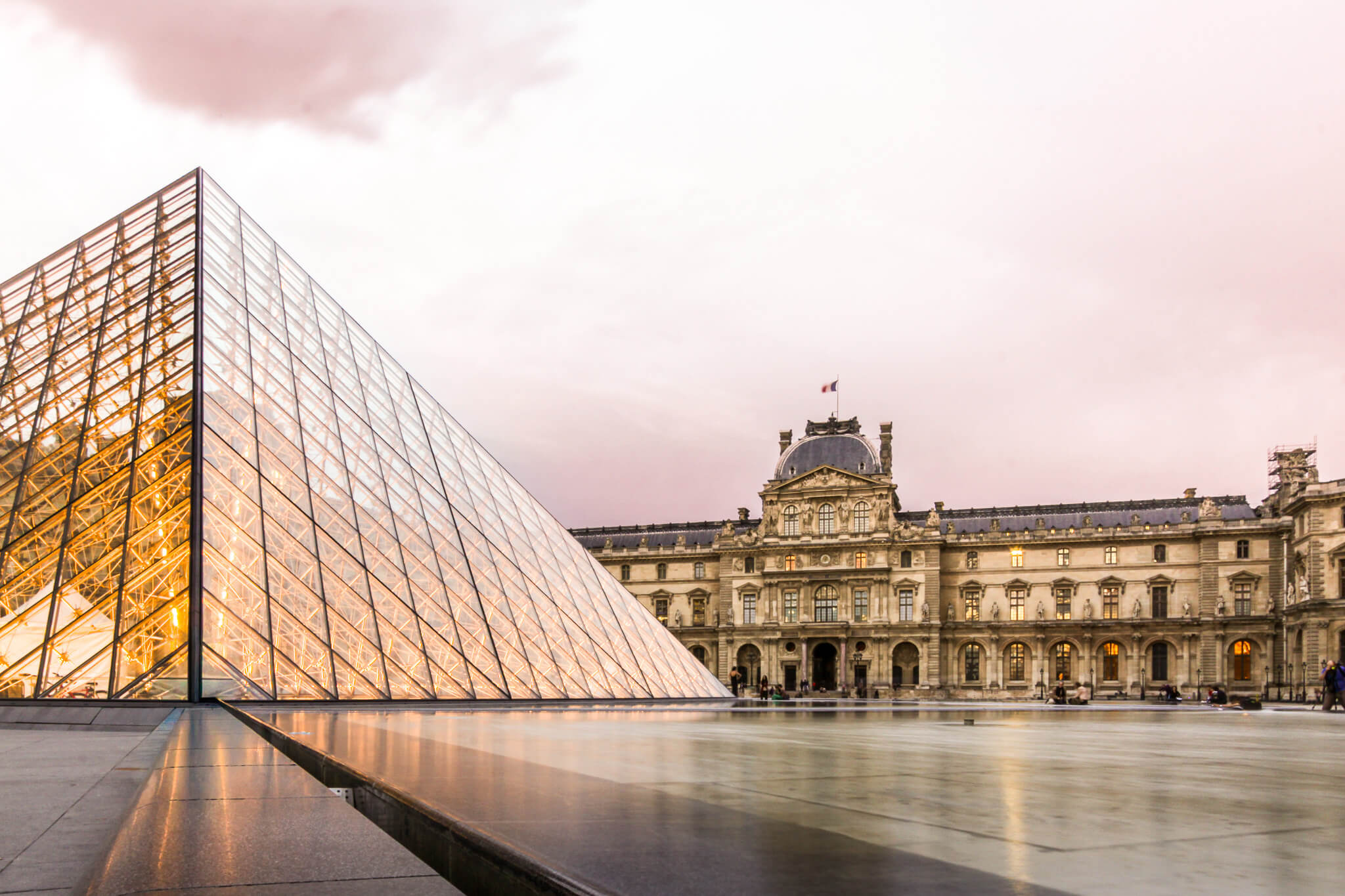
Named after the Louvre museum, the 1er arrondissement of Paris is the literal centre of Paris and is home to some of its most famous attractions. It’s impossible to visit Paris without spending at least a few days in this area.
We spent 3 days visiting the 1st arrondissement because of the time we dedicated to museums. If you cut the museum time a bit, you could still easily fill 2 days. If you reduce museums to a minimum, you could see quite a bit in a single day.
The Louvre Palace and museum


The Louvre is the largest art museum in the world. Even if you’re not an art aficionado, it’s still well worth a visit. The museum building was once a palace for the kings of France, built on top of a medieval fortress (whose foundations may be visited as part of the museum). The architecture of the building itself is enough to captivate visitors. Even if you ignored all the paintings, you could fill your time admiring sculpture and antiquities.


Despite visiting the Louvre on previous visits, we still gave ourselves a full day to do a thorough visit of the museum. We purchased timed-entry tickets for 9am and stayed until 5pm. We wandered through most of the museum, going slowly through areas that interested us, and more quickly through areas of less interest. I’ll write a separate post on our Louvre highlights.
If you’re spending an entire day in the Louvre, be aware that there are limited food options inside the museum itself, and they do not allow re-entry. We had lunch at Café Richelieu, near the sculpture gardens of Cour Marly and Cour Puget. While the lunch was arguably overpriced, we thoroughly enjoyed a bottle of rosé wine and small croque-monsieur sandwiches on the terrace overlooking the Louvre pyramid and main courtyard. Service was impeccable and the view was priceless.
Jardin des Tuileries
Beyond the Louvre is the Jardin des Tuileries, a large formal garden created for Catherine de Medici opposite her Tuileries Palace in 1564. It would later welcome the public in 1667, and after the French Revolution became a fully public park.


The park is aligned on a strict grid, with rows of trees delineating peaceful walking paths. At either end are large ponds surrounded by green lawn chairs where one can relax and watch people stroll by. The park is popular with morning joggers, and is the perfect place to find a bit of peace after a hectic day in Paris.
It is currently home to the 2024 Olympic cauldron, designed as a hot air balloon.
Île de la Cité: Sainte-Chapelle and the Conciergerie
The 1er arrondissement also contains the western tip of Île de la Cité, an island in the middle of the Seine river.


Like the Louvre, the Conciergerie is also a former royal palace (the Palais de la Cité), which gradually become a prison when the royals moved to the Louvre. This is famously where Marie Antoinette was imprisoned before her execution. Much of the building is currently used as a court house, but visitors can tour the 14th-century Gothic halls, guard rooms and a commemorative chapel built that was once Marie Antoinette’s prison cell. We decided to skip an interior visit, though we’re sure we would have been impressed by the grand halls.
If you can afford a detour to the Sainte-Chapelle, it’s worth the quick visit that it requires. It was a royal chapel completed in 1248 within the medieval Palais de la Cité for Louis IX to house his religious relics, and is a masterpiece of the Rayonnant period of Gothic architecture. Compared to the Gothic Notre-Dame, the Rayonnant style becomes obvious: everything is taller, lighter and brighter. The upper chapel of Sainte-Chapelle is seemingly a structure made entirely of stained glass, with only the smallest of supports holding everything together. The simpler lower chapel was intended for the other residents of the palace.
The royal squares of Paris


Paris features five royal squares, and the most centrally-located one is Place Dauphine, near the western top of Île de la Cité. This triangular square was completed in the early 1600s and dedicated to the Dauphin, the eldest son of the King of France. It’s lined with historic residences, although the buildings at the “base” of the triangle were demolished to provide a view of the Palais de Justice (part of the Conciergerie complex). The square is a quaint space, lined with pink horse chestnut trees (originally they were white-flowered chestnuts).
Continuing onwards, we pass an equestrian statue of King Henry IV on Pont Neuf (which translates to “New Bridge” despite being the oldest standing bridge across the Seine in Paris). This leads to the very tip of the island, the Square du Vert-Galant (King Henry IV was known as the “Vert Galant”). The park is about 7 metres lower than the rest of the island, closer to the previous elevation of the rest of the island. Because it’s so low, it gets completely flooded frequently.

Another royal square in the 1er arrondissement is Place Vendôme, just north of the Jardin des Tuileries. It’s by far the most cohesive and handsome of the squares. At the centre is the Vendôme Column, commissioned by Napoleon and modelled after Trajan’s Column in Rome. The square is bordered by matching townhouses built for wealthy aristocrats, financiers, and high-ranking officials. Nowadays, the townhome buildings are home to the Ritz Paris and shops for the all the top luxury brands.
The Palais-Royal courtyard

The Palais-Royal is a former French royal palace only a block north of the Louvre. It was originally built for Cardinal Richelieu in the 1630s and called the Palais-Cardinal. It passed into royal hands when Richelieu bequeathed it to Louis XIII. The Palais-Royal now houses the Ministry of Culture and other French governmental organizations.
The central courtyard is public park with central pond. A colonnade crosses the courtyard and the arcade surrounding the inter courtyard houses shops and hotel restaurants.
World-famous hot chocolate at Angelina


We took a risk and decided to visit the famous Angelina tea house, which gets promoted in every Paris travel guide book, blog and TikTok. They are said to make the best hot chocolate in Paris, so we had to test it out (but only if we could get in without queuing up).
So we headed to Angelina on rue Rivoli (opposite the Tuileries Garden) for opening hour at 8am. We were the second table to be seated in the expansive dining room (without lining up!). We ordered the “petit déjeuner Parisien”, which includes a hot chocolate (served with whipped cream on the side; option for coffee or tea instead), freshly squeezed juice (we chose grapefruit), a mini croissant and pain au chocolat, and baguette with French AOC butter, jams and honey.
The hot chocolate definitely lived up to its reputation. It’s so thick it seems to be pure chocolate thinned out with only the smallest amount of cream. And with only a hint of sweetness. Everything else was of a similar quality: the grapefruit juice was delightfully tangy, the vienoisseries were buttery and flaky, and the baguette was simultaneously crunchy and soft.
It was a splurge, but it was thoroughly enjoyable. Would I wait in line more than 10 minutes to get in? Probably not.

Shopping with an architectural flair
La Samaritaine is a large department store at the heart of Paris that combines architectural elements of both Art Nouveau and Art Deco. It’s worth popping inside to see the stunning glass roof, the wall mosaics on the top floor, and the cast iron supports and railings throughout.
A few block north of La Samaritaine, we stumble upon the Westfield Forum des Halles, a new, mostly underground mall that was completed only 10 years ago. The area (“Les Halles”) has housed market activity for nearly 800 years, evolving into the city’s main fresh food market. That market closed in 1973 and was replaced by an original shopping centre and park in 1979 which proved unpopular. It was demolished in 2010 and replaced by a modern successor, completed in 2018. Today it’s a lively mall with big-name shops and attracts some 50 million shoppers each year.


Église Saint-Eustache
Église Saint-Eustache often gets overlooked by tourists (who flock to Notre-Dame). It’s a shame because Saint-Eustache is nearly as large (same width, same vault height, but 25m shorter in length) and is more ornate and decorated than Notre-Dame, owing to its later Flamboyant Gothic style and Renaissance decorations.


Curiously (and very questionably), the front façade was entirely rebuilt in a neoclassical style after work on some chapels compromised the structural integrity of the façade and forced a renovation. Saint-Eustache dominates sight lines as you walk from La Samaritaine towards Les Halles.
La Bourse de Commerce

At the west end of Les Halles is the Bourse de Commerce. Now a contemporary art museum, it was originally a grain and wheat exchange and storage facility incorporated into the original Les Halles market.
The 1er arrondissement of Paris features some of the most iconic attractions in the city including the Louvre, the Tuileries Garden, Sainte-Chapelle and more. But getting off the beaten track reveals other sights, including two royal squares, two former royal palaces and shopping centres inside architectural wonders. What are your favourite spots in the 1st arrondissement?
Leave a Reply